

Implementing Process Harmonization in discrete manufacturing industries demands a comprehensive and thoughtful strategy. When executed effectively, the advantages can be substantial, positively impacting both the operational environment and financial performance of our clients.
- Define Design Principals: – We need to Define the design principles that will guide our clients process harmonization initiatives. Clearly articulate the objectives we aim to achieve, ensuring that our business process harmonization team can focus efforts on the most critical dimensions of value. Some of the principles could be – Standardization in processes and procedures across business units, Lean and simplified processes for efficiency improvement, Scalable to accommodate growth and changes in production volumes, Data driven decision making, improving time to market, etc.
- Use Standard Frameworks: – Standard frameworks accepted across multiple industries to model the processes and the associated data can be evaluated and utilised. This ensures consistency, facilitates understanding, and promotes interoperability across different parts of the organization.At TTL, since we deal with discrete manufacturing industries, several standard frameworks can be utilized to model processes and associated data, ensuring consistency, facilitating understanding, and promoting interoperability across the client organization. Some widely accepted frameworks are:
- APQC Process Classification Framework (PCF): The APQC PCF provides a common language for organizations to describe their processes comprehensively. It helps in benchmarking, process improvement, and harmonization efforts.
- BPMN (Business Process Model and Notation): BPMN is a graphical representation for specifying business processes in a workflow. It is an industry standard for process modelling and provides a notation that is understandable by all business users.
- ISA-95 (International Society of Automation): ISA-95 is a standard for the integration of enterprise and control systems. It provides a structured way to model the relationships between business and manufacturing processes.
- SCOR (Supply Chain Operations Reference) Model: The SCOR model is a process reference model for supply chain management. It includes standard descriptions of management processes, a framework of relationships among the standard processes, and metrics to measure performance.
- Lean Manufacturing Frameworks: Lean principles and methodologies, such as Value Stream Mapping (VSM), can be used to identify waste and improve processes. These frameworks focus on optimizing production processes and enhancing efficiency.
- TOGAF (The Open Group Architecture Framework): TOGAF provides a high-level approach to design, plan, implement, and govern enterprise information architecture. It can be applied to align IT with business goals in the context of process harmonization.
- ITIL (Information Technology Infrastructure Library): ITIL provides detailed practices for IT service management (ITSM) that focuses on aligning IT services with business needs. Although ITIL is more IT-focused, its principles can be applied to support process standardization and harmonization.
- People and Systems: – In our approach, we can concentrate on the people and systems executing the processes. Process harmonization goes beyond merely creating a process map. It involves engaging with individuals to change mindsets and work practices. Successful harmonization requires collaboration, communication, and training to ensure everyone is aligned with the new processes.
- Implement measures to evaluate the extent of process harmonization: – Without objective measurement, assessing the success of harmonization efforts remains subjective. To demonstrate the value-added by process harmonization, we need to clearly define how we will measure improvements from the current state to the desired future state. This should include specific metrics and key performance indicators (KPIs) to track progress and outcomes. Key Technical Points for Evaluating Process Harmonization in PLM could be:
- Process Efficiency – Some of the examples are:
- Overall Cycle Time Reduction: Track the time taken for each phase of the product lifecycle, from design to disposal.
- Process Throughput: Measure the number of products passing through each stage within a given timeframe.
- Collaboration and Communication – Some of the examples are:
- Collaboration Metrics:Evaluate the effectiveness of communication and collaboration tools among cross-functional teams.
- Internal Turnaround and Approval Times:Measure the time taken for design and process approvals across different departments.
- Change Management – Some of the examples are:
- Change Request Turnaround Time:Track the time taken to process change requests and implement changes.
- Impact Analysis Effectiveness:Measure the accuracy and thoroughness of impact analyses for proposed changes.
- Compliance and Standardization – Some of the examples are:
- Regulatory Compliance Rate: Measure the rate of adherence to industry regulations and standards.
- Standard Operating Procedure (SOP) Adherence:Track adherence to standardized processes and procedures.
- Cost Management – Some of the examples are:
- Cost of Quality: Measure costs associated with ensuring product quality, including inspection, testing, and rework.
- Cost Savings from Harmonization: Calculate cost reductions achieved through streamlined and harmonized processes.
- Innovation and Development – Some of the examples are:
- Time to Market: Measure the time taken from initial product concept to market launch.
- New Product Introduction (NPI) Success Rate: Track the success rate of new product launches.
- Customer Satisfaction – Some of the examples are:
- Customer Feedback: Collect and analyse customer feedback related to product quality and lifecycle processes.
- Return Rates and Warranty Claims: Measure product return rates and warranty claims as indicators of product quality and process effectiveness.
- PLM System Performance – Some of the examples are:
- System Uptime and Reliability: Track the uptime and reliability of the PLM system.
- System Integration Success: Measure the success rate of integrations with other enterprise systems (e.g., ERP, SCM).
- Training and Adoption – Some of the examples are:
- User Training Completion Rate: Measure the percentage of users who have completed training on harmonized processes.
- User Adoption Rate: Track the adoption rate of new processes and tools among employees.
- Process Efficiency – Some of the examples are:
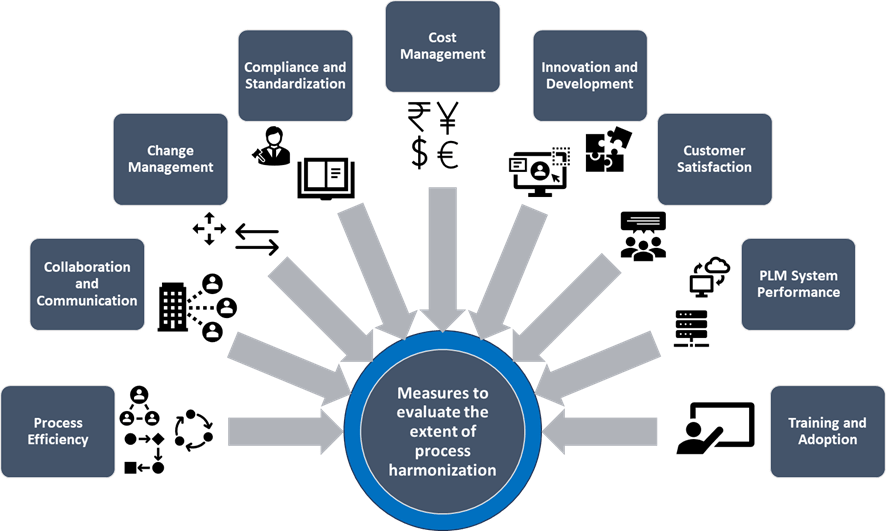
By defining and monitoring these metrics and KPIs, we can objectively evaluate the extent of process harmonization within our clients digital Landscape. This approach ensures that improvements are measurable and that the value added by harmonization efforts is clearly demonstrated.


Leave a Reply