
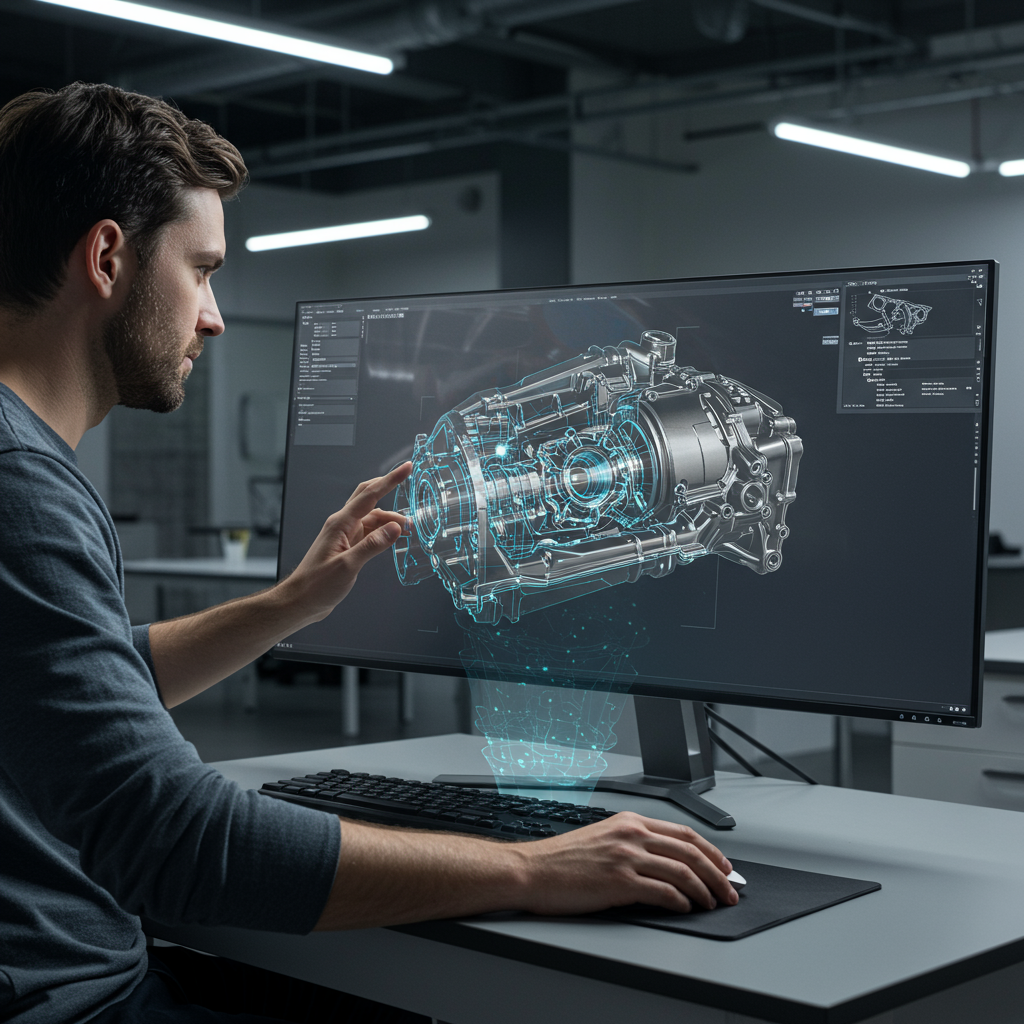

When most people think of 3D CAD software, they picture digital blueprints or complex models of machine parts. For decades, that was its primary role: a tool for documenting an idea. However, that technology has fundamentally transformed from a passive documentation tool into an active partner in innovation. Today’s advanced design platforms are comprehensive ecosystems actively shaping everything from the cars we drive and the products we use to our potential for life on other planets.
This article explores five of the most impactful and surprising transformations in this field, using the capabilities of CATIA and the 3DEXPERIENCE platform as a central example. These shifts reveal a new reality where software is no longer just for designing products, but for experiencing the future.
1. It’s No Longer Just “Computer-Aided Design”—It’s “Cognitive Augmented Design”
The fundamental concept of design software has shifted. We’ve moved beyond simple Computer-Aided Design (CAD) into an era of “cognitive augmented design.” This new paradigm fuses the once-separate disciplines of modeling and simulation into a single, intelligent process.

This evolution means the software is no longer a passive tool waiting for commands but an active partner in innovation. By leveraging embedded knowledge and know-how, it can automate complex design and systems engineering tasks. This is significant because it dramatically accelerates development cycles and empowers designers and engineers to solve more intricate problems than ever before. This shift to a collaborative intelligence is the foundation for the game-changing capabilities that follow.
2. They’re Building an “Internet of Experiences,” Not Just Products
The focus of modern design has expanded from individual objects to the entire ecosystem they inhabit. This is the core idea behind the “Internet of Experiences”—the creation of smart and autonomous virtual experiences that “digitally connect products, nature and life in the real world.” This is made possible by the software’s advanced ability to model and simulate cyber-physical systems, integrating everything from mechanical components and electronics to software and control systems within a single model.
This ambition is realized through the power of the Virtual Twin, which provides the dynamic, high-fidelity model needed to simulate these complex interactions. Instead of just designing a car, teams now design the entire driving experience, from the user interface and autonomous systems to its interaction with smart city infrastructure, all within a unified digital environment.
3. The “Virtual Twin” Is a Game-Changer for Making the Right Decision
One of the most powerful tools in the modern innovation toolkit is the “Virtual Twin.” This is a high-fidelity, dynamic, and unified digital twin of a product, system, or even an entire factory that serves as the single source of truth throughout the development lifecycle. It provides the clarity needed for accurate decision-making at every stage.
The benefits are immense. Teams can perform virtual assembly to check for fit and finish, validate ergonomics to ensure usability, and simulate performance under real-world conditions. The impact of this is profound: it allows companies to test, iterate, and perfect products in the digital realm, drastically reducing the reliance on expensive physical prototypes and catching costly errors long before they can make it to the production line.
4. It’s an Artist’s Tool for Sculpting Perfect “Class-A” Surfaces
Modern design software has blurred the line between engineering and artistry. Achieving “surface excellence”—known in the automotive industry as “Automotive Class-A Surfaces”—represents the highest possible level of surface sophistication and quality and is a key factor in a product’s market success. This requires tools that are as creative as they are precise.

Solutions like CATIA Design & Styling provide a unified workflow that combines creative tools, such as 3D sketching and subdivision surface modeling, with the high-end technical surfacing required for production. This integration allows designers and engineers to collaborate seamlessly, ensuring that the final product is not only functional and manufacturable but also aesthetically pleasing and ergonomic, meeting the high expectations of today’s consumers.
5. It’s Engineering Our Future on Earth—And Beyond
The most forward-looking application of this technology isn’t just about improving today’s products; it’s about building tomorrow’s world. A powerful example is Interstellar Lab, a company developing “environmentally controlled, closed-loop modules designed for self-sustainable life on Earth and other planets.”
To achieve this ambitious goal, their multidisciplinary team uses the 3DEXPERIENCE platform to bring together expertise in architecture, engineering, and agronomy, allowing them to innovate at high speed. As their Chief Product Officer, Jim Rhoné, states, the platform is a crucial enabler for their mission:
3DEXPERIENCE is a game changer for us as we’re able to design and iterate at speed, bringing all our expertise together in one place to come up with the best solutions.
Conclusion: A New Foundation for Innovation
Advanced design platforms have evolved far beyond their origins as digital drafting tables. This evolution—from a digital drafting table to a platform for cognitive augmented design—is what makes the unified Virtual Twin possible, which in turn allows for the creation of the Internet of Experiences. By providing a unified foundation that fuses modeling with simulation and artistry with engineering, they empower teams to build not just better products, but entirely new ways of living.
As these tools continue to fuse the digital and physical worlds, what complex global challenges will we be able to design solutions for next?
For more information or to set-up a demo, please complete the form below:


Leave a Reply