
This blog is the continuation of the previous one on non-linear mechanics and materials. Again, the enhancements in both FD’s of 2023x as well as 2024x are included. So, let’s get started.
Film loading improvement: It may seem counter intuitive to begin with. In a film condition defined for a steady state thermal model, the sink temperature is ramped up from zero by default if no amplitude is defined. Ideally sink temperature should never change. This introduces artificial heat fluxes due to ramped behavior of sink temperature. Usually, we disregard the intermediate results of a steady state model but if there are prominent thermal non-linearities in the material, these pseudo fluxes can impact the final state of the model as well. The algorithm has been improved to fix this problem. The graph below shows the improved behavior based on 100 C of sink temperature.

Film Loading UI Enhancement: For the sake of usability, the AMPLITUDE keyword has now been divided into Sink amplitude and Film amplitude for convection as well as Ambient Amplitude and Radiation Amplitude for radiation.
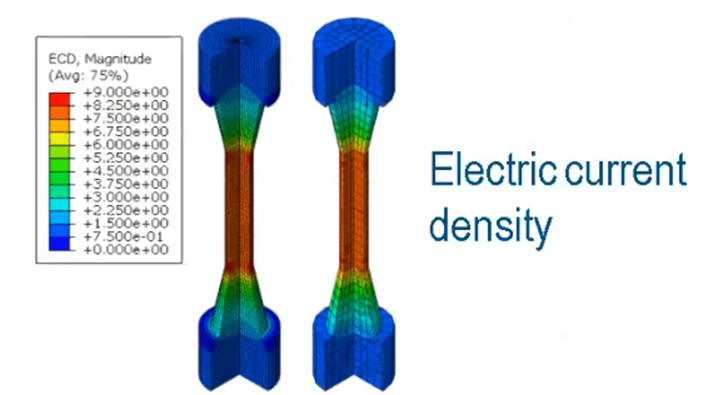
Element Enhancements: The axisymmetric coupled thermal electrical structural elements have been introduced in Abaqus standard. Earlier such kind of coupling required 3D solid elements. These elements are QAX3, QAX4, QAX6 and QAX8. DOF 1-2 refers to radial and axial displacements, DOF 9 is electric potential and DOF 11 is temperature. Common practical applications are electrical connection between probes.

Connector element has been modified to model SLIPRINGS which is material flow and stretching between two points on a frictional pulley belt system. The contact angle, alpha, can be either constant or updated with analysis based on how it is defined in keywords.

Cohesive Offset in Geophysical Applications: In hydraulic drilling operations, the pressurized fracture fluid may leave the crack opening as the fluid injection stops. This may lead to complete closure of the crack under stresses perpendicular to crack surface. If slurry particles are introduced in the fluid, they can provide resistance to closure.
In terms of simulation, COHESIVEOFFSET and UXFEMCRACK routines have been introduced to model such crack closure behavior. If normal separation of a crack is below the cohesive offset, significant resistance is introduced to keep the crack open.
Adjoint Sensitivities for composite shells: The sizing sensitivity for composite shells is now possible with layer thickness and fiber angle as design variables. All the static and transient dynamic responses are supported. Eigen frequency support would be available in 2024xFD01.


Leave a Reply