

A very happy and prosperous new year 2024 to all our subscribers. We are in 2024 and 2024x release is available for download as well. However, before getting into 2024x, let me wrap with one final post on the 2023x release updates. The enhancements in TOSCA are quite interesting and useful.
- Crack Growth with Adaptive Remeshing
This new feature utilize a novel non-XFEM based contour integral to compute energy rates. Abaqus static is used with Franc-3D for all fracture remeshing and fracture calculations. The application is limited to linear elastic and brittle materials. Abaqus viewer lug in has been developed for post processing which creates number of png files at different stages of crack propagation. One can use Camtasia or other image processing tools to create an animation from these snapshots.


- Hydraulic fracture enhancement:
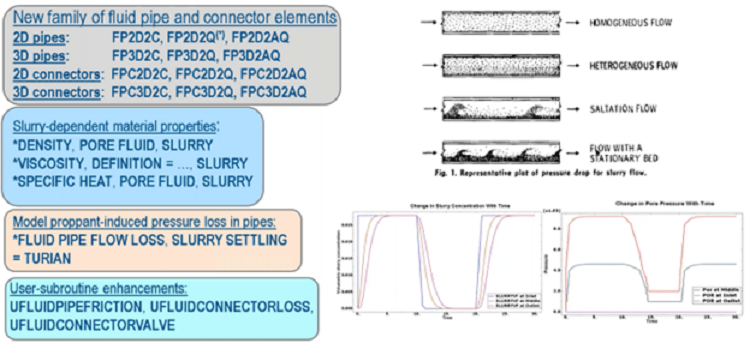
The method now includes slurry transport through the borehole. Enhanced borehole modeling with new fluid pipe and fluid pipe connector elements. Both cohesive zone and XFEM based methods have been enhanced. Phenomenon such as slurry solidification also called as sand screen effect and fluid leakage also considered. Slurry transport uses the USETTING routine to model slurry settings behavior. An artificial diffusion is utilized.

- Beam Enhancements 2023xFD01
Horizontal offset introduced for C-sections. The vertical offset already exists. The beam offset can now be defined with *BEAM General Section in Abaqus explicit.
- Motion Enhancement 2023xFD01
Axis of rotation for enforced rotation can now be defined using nodes instead of points. Axis of rotation can shift during simulation, if required. This is useful in the brake squeal analysis. However, the update of axis is done only once at the start of the step.
*MOTION, ROTATION, DEFINITION=NODES
TOSCA UPDATES 2023x
- Sensitivity Enhancements 2022xFD01
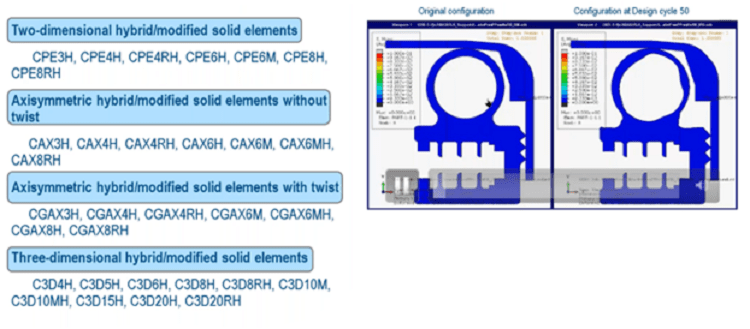
The hybrid and modified elements of Abaqus now support shape optimization. A very useful update in the optimization of seals and other elastomer products.

- Pre Loading Optimization 2023xFD02
Perturbation step followed by general static effect was limited to topology optimization only. Now the capability has been extended to shape, size and bead optimization.
- Sizing Optimization for Composites 2023xFD01
Various parameters of composites such as layer thickness, layer orientation can be used as design variables in TOSCA. These design variables can either be uniform or vary spatially using distribution table.
- Extended Multiphysics Capabilities
Thermal-Structure and Electromagnetic-structure optimization; Two physics might conflict each other and each physics may lead to a different optimal design. It’s the same situation as multiple load case optimization in which each load case gives a different result. Sequential optimization is of limited use in such a case. Coupled optimization is rather the right approach by using multiple input decks for thermal and structural in a single TOSCA job.


- CST Studio in optimization
TOSCA can now use the CST solver for electromagnetic optimization for both low frequency and high frequency problems. The workflow is defined in the CST studio suite and it appears as follows:


- Restarts in TOSCA
This is a big one and much awaited enhancement. If the job fails prematurely, either TOSCA or the underlying Abaqus, the optimization can start from where it failed with the modified parameters. As in case of Abaqus restart, there are some restrictions of course on which parameters can be modified. Mesh changes are not permitted but the number of design cycles, convergence criteria type of parameters can be modified.
- Bead Optimization Enhancement
The shell penetration check now considers thickness and offset. Previously only mid surface was considered by TOSCA for the offset.


ISIGHT UPDATES 2023x
- New “threshold” parameter has been introduced for certain distributions. Default value is zero which is equivalent to no threshold.
- Simflows can now be hidden in the webtop i.e. browser based search. The control is managed in the webtop application server by the webtop administrator.
- In latest SEE, webtop can be linked to the documentation server only. The HTML based documentation cannot be linked.
- The Abaqus component has been upgraded to support 6.14 to 2023x releases.